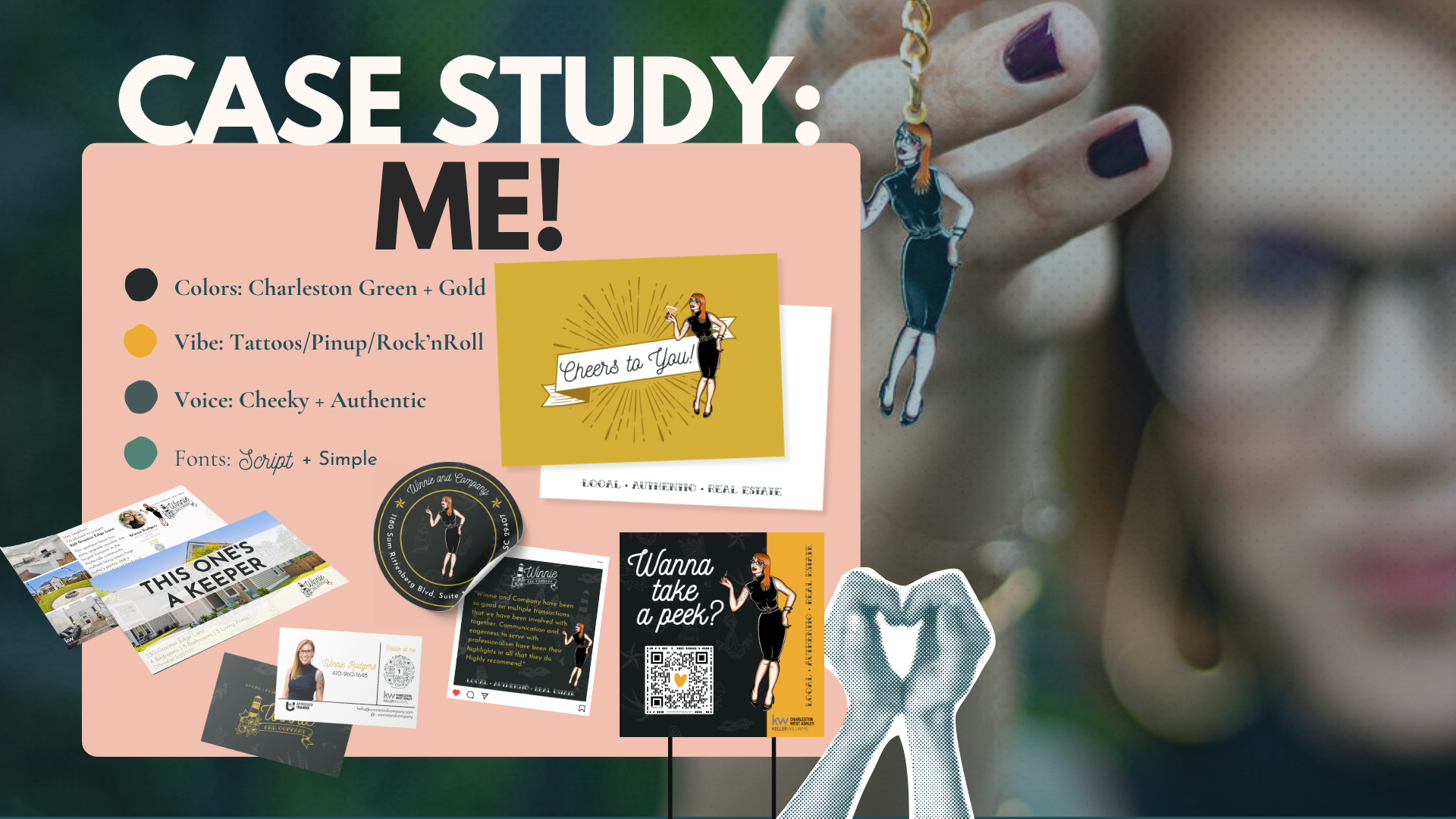
This is what brand alignment looks like. Winnie's visual identity, from business cards to yard signs, all unmistakably her.
What does it actually mean to have a real estate brand?
A real estate brand is not a logo, a color palette, or a Canva template. It is the combination of your values, your voice, your visual identity, and your content strategy. It all works together to create a consistent, recognizable presence that makes the right real estate clients choose you before they ever make the call.
We have been talking a lot lately about what bad real estate branding looks like. The maximalist AI-generated graphics, the overcrowded listing flyers, the sea of sameness that used to be forgettable, but is not just tacky.
So today we want to flip it.
Before we get into the framework, watch Winnie teach this live.
This is the presentation that started it all.
Watch: What We Miss About Branding — Winnie Rodgers, REM Real Estate Marketing
What does a real brand actually look like? And more importantly, how do you build one?
Here is the four-step framework REM uses with every single client.
Step 1: Start With Who You Are, Not What You Look Like
92% of marketers believe authenticity is a crucial part of brand identity and yet most agents skip this step entirely and go straight to Canva.
Before you pick a color palette, before you choose a font, before you design a single graphic, you need to know three things: your values, your skills, and your passions. Not the polished version you put on your website - the real ones. These show up in how you communicate with clients, what you talk about at dinner, and why you got into this industry in the first place.
At REM, we ask every client to identify three values (your non-negotiables), two unique skills you bring to the table (negotiating, construction background, numbers wiz), and one passion (something that makes time cease to exist) before we do anything else. These are not words for your bio. They are the foundation that every design decision, every caption, and every piece of marketing gets built on top of.
Winnie's brand references rock and roll, Charleston, and vintage pinup culture because that is actually who she is. Her clients do not all love rock and roll. But they see someone showing up the same way every single time, and they trust her because of it.
That is brand alignment. And it is where every strong real estate brand starts.
The call to action here: Write down three values, two skills, and your passion before you open any design tool. If you cannot name them, your brand will not be able to show them.
Step 2: Understand That Design Is the Visual Language of Credibility
94% of first impressions are design related. *
Your brochures, your yard signs, your social graphics, your email newsletter, and yes, your voicemail greeting… every single touchpoint tells people something about who you are. If your design is inconsistent or off-brand, what you are communicating is that your business is inconsistent and off-brand.
This does not mean you need to spend a fortune on a designer. It means you need a system.
What a solid visual identity includes:
Three to four brand colors. Three is preferred (light, dark, and pop). Each color should have a reason to exist in your brand beyond "I liked it."
A clear font pairing. A display or serif font for headers, a clean sans-serif for body copy. These two fonts should appear consistently across every piece of marketing you produce.
On-brand headshots. Not just professional, but actually on-brand. Your headshots should feel like they came from the same world as your Instagram grid, your listing flyers, or even your dining room.
A visual identity system, not just a logo. Your logo is one element. The full system is the colors, the fonts, the photography style, and the way all of those things work together across every platform.
When all of those things feel like they came from the same place, that is a brand. When they do not, that is a collection of assets that breaks trust.
Design is the visual language of credibility. If your design is inconsistent, people will assume your business is too.
Step 3: Build a Content Strategy, Not Just a Content Calendar
Most agents think a content strategy is a calendar. It is not.
A content strategy is your voice, your goals, your audience, your value proposition, your keywords, and your platforms. It answers four questions every single time you create something:
What am I posting?
Why am I posting it?
What do I want the person to feel, believe, or do after they see it?
What am I not posting? (this is our favorite!)
That last question matters more than most agents realize. Authenticity does not mean everyone gets full access to your life. Your strategy also defines what stays private., what is sacred, what you will not share, no matter how well it might perform.
Your content pillars are the framework that makes this consistent.
Content pillars are the categories of content that belong on your channels. They are the what and the why behind every post. Without them, every piece of content is a decision made from scratch. With them, every piece of content has a home and a purpose.
Most agents need between four and five content pillars. They might include things like: your real estate business, your community, your unique value proposition, and your passion (with an extra pillar just in case!). The specifics depend entirely on who you are and who you are trying to reach.
What a content strategy is not:
It is not a trend. Trends confuse your strategy and they confuse your clients. If a trend aligns with your actual values, passions, or skills, use it. If it does not, skip it. You are not singing for your supper and you should not market like you are.
Step 4: Post With Depth, Not Volume
The biggest myth in real estate marketing is that you need to post more.
You do not need to post more. You need to post better.
Posting more without a strategy underneath it produces more noise. And the real estate space already has plenty of noise. What it does not have enough of is agents who post with depth, intention, and a clear point of view.
A single post that teaches something specific, takes a clear position, and sounds unmistakably like the person behind it will always outperform five posts that could have come from anyone.
Clarity builds trust and confidence.
When you know who you are, what you stand for, and how you show up, the posting becomes easier. The content becomes more natural and the right clients start finding you because your brand is finally doing the work it was built to do.
That is the framework. And it works.
Every. Single. Time.
Frequently Asked Questions
What is real estate brand strategy?
Real estate brand strategy is the process of defining an agent's values, voice, visual identity, audience, unique value proposition, and content pillars so that every piece of marketing they produce feels consistent, intentional, and recognizable. It is the foundation that everything else, including social media, newsletters, and listing marketing, is built on top of.
Why isn't my real estate content converting?
Usually it is not a posting problem, it is a brand problem. When content does not have a clear point of view (or doesn’t really say anything specific), no one remembers who posted it. Strategy comes first, then consistency, and that combination is what actually moves leads.
How do I build a personal brand as a real estate agent?
Start with your values, skills, and passions before you touch any design tool. Then build a visual identity system that reflects those things consistently. Then create a content strategy that answers what you are posting, why you are posting it, and what you want your audience to feel, believe, or do after they see it.
What does a real estate branding agency do?
A real estate branding agency defines an agent's visual identity, voice, and content strategy so their marketing actually reflects who they are, instead of copying a template that could belong to anyone. REM's process starts with a 90-minute Brand Blast-Off session and builds from there.
How much should a real estate agent spend on branding?
It depends on what you need. REM's Brand and Content Strategy starts with the Brand Blast-Off and builds out into custom marketing kits, social media management, and newsletter management. The right investment is the one that produces a system you can actually maintain consistently, because consistency is the product.
If you are ready to stop guessing and start building, the first step is a Clarity Call.